
Maintaining the Bridges
Thoughts and analogies about infrastructure...
I live in Pittsburgh, Pennsylvania — “The Steel City,” once the beating heart of American steelmaking. In 1902, U.S. Steel’s first full year of operation, it produced 67% of all steel in the United States. By 1943, the company employed more than 340,000 people. We burned so much coal that Pittsburgh earned the nickname “Hell with the lid off.” Streetlights sometimes ran at noon because the sky was that dark.

The city’s geography didn’t make things any easier. Pittsburgh is carved by mountains, valleys, and the three rivers — the Allegheny and Monongahela merging to form the Ohio. That topography, combined with the industrial boom, meant we built a lot of bridges. It helps that when your city is literally manufacturing the materials, you get a hometown discount.
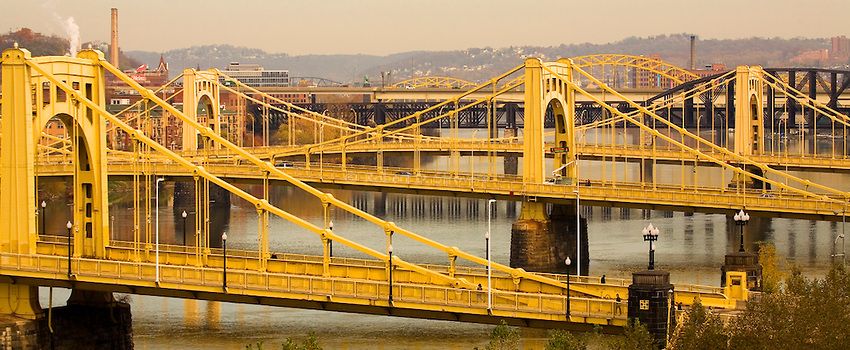
One of them, the Hot Metal Bridge — just a mile or two from my house — once carried ladle cars full of molten iron between the blast furnaces and mills of J&L Steel. During World War II, 15% of America’s steelmaking capacity crossed that bridge, up to 180 tons per hour.
These bridges were originally built by private companies with a clear profit motive: to move coal, ore, steel, or workers. Others were toll bridges, run by private companies the way you’d run a turnpike or ferry.
But more bridges meant more industry, which meant more people, which meant more bridges. You can see where this goes.
Even by the late 1800s we were beginning to publicly fund them. By the 1920s–1930s Allegheny County’s bridge program bought out many of the private bridges and replaced many of them. By the time the New Deal and Interstate era arrived, the private‑toll era was basically over - and since then over 90% of Pittsburgh's public bridges were funded by federal programs (we still have some private industry use bridges).
So what does any of this have to do with software?
Aside from giving me an excuse to talk about my city (which I enjoy), Pittsburgh’s bridges are a useful metaphor for the infrastructure we rely on in tech, in two important ways:
Becoming a public good Private investment built early bridges, just like private companies built much of what we've got now in terms of browser engines, search index, foundational libraries and so on - but eventually they stopped becoming optional. I think we're only now starting to really understand that we need a lot of this to be a public good in the same kind of way. These are the roads and bridges of the modern world.
Building something new is exciting. Maintaining it, not so much. A lot of my city's physical infrastructure is aging and some of it has been neglected. It's somehow way easier to get people to build new things than to take care of the old stuff. The public notices a new bridge! The ribbon-cutting gets a photo op and celebration. The maintenance budgets and crews struggle to even get funding.
In fact, even when things are fairly well funded, it doesn't mean they're kept up to date. While researching to write this piece I realized that a lot of the Wikipedia data about Pittsburgh (and many topics!) is actually really out of date. It's cool to write the article with these cool facts, but it's not so cool to do the work to keep it up... Or, maybe thats just not what you want to do anymore. Or maybe you were incarcerated, or you died, or you went to Mars - idk.
The point is that writing the thing in the first place is only half the battle. If most of your entry on a city was written two decades ago, a lot of what it details about the economics, population, jobs, and so on are probably not very accurate!
It's no different with software. It's cool and fun to build a new thing or add a new feature to an existing thing, but keeping them maintained is annoying. New mechanisms arrive that you might need to adapt to. Underlying code bit rots. All of it needs release teams and Q&A and reviews and fixes and updates at global scales, even if no new features were added. But very few people actually want to do that, and almost nobody wants to pay for it.
More Public Funding
I'd really love for societies around the world to come to the realization that a lot of the online things we've built are, like roads and bridges, now necessary - and figure out how we can publicly fund enough of them that important things without an obvious and direct profit motive can get done. MathML and SVG are two easy examples of this, but there are plenty more. Maybe XSLT is another example. Perhaps if we had good funding for those things, their ongoing survival wouldn't be questioned.
I feel like there is a lot of room here for improvement from the status quo. It doesn't even have to start with governments. Any ways that we expand the pool of funding avilable and diversifying, it helps.